Should Your Business Build on Shopify?
Our evidence-based recommendation for business owners considering the Shopify ecommerce platform.
Shopify earns a Reviewed™ designation from Certify Digital™ — a strong, well-evidenced recommendation with two specific things worth knowing going in: a documented history of security incidents tied to its app ecosystem, and support quality that depends on which plan you’re on.
Neither is a dealbreaker. Both are exactly the kind of thing you’d want a friend who’s used the platform for years to tell you before you sign up — not to talk you out of it, but so nothing catches you off guard.
If you’re currently building, growing or running an online store, Shopify should be at the top of your list.
Table of Contents
Who Shopify Is Best For
Shopify is well suited for your business if you:
- Are launching a new store and want a widely-supported, proven platform
- Expect your needs to grow or change over time — subscriptions, loyalty, advanced marketing — and want a platform with mature solutions already available when you get there
- You want to partner with people and teams who already know the platform
- Prefer a large app marketplace instead of a team of in-house web devs constantly building new, custom, one-off integrations
Who Should Look Elsewhere
Shopify is likely not the right platform if you:
- Have highly specialized/unusual technical requirements not well served by the app ecosystem
- Are highly cost-sensitive at low transaction volumes. In other words, your flat monthly costs plus app subscriptions outweigh alternatives
- Need complete control over your codebase and infrastructure. In these cases, going headless or fully custom may serve you better.
- Have already invested heavily in a competing platform (WooCommerce, BigCommerce) and you have no serious reason to migrate
Why We Recommend It
The Real Advantage Is The Ecosystem
Most people love to say that Shopify’s chief advantage is the marketplace with over “8,000+ apps.”
But that number alone doesn’t tell you ‘why‘ it truly matters.
But the reason is simple…
Your store’s needs today are not going to be your store’s needs six months from now.
You might need only a website and cart today, but down the road, you may need email marketing, product reviews, loyalty rewards, subscriptions, upsells, advanced search, shipping automation, inventory management, support tooling, analytics, and international selling support.
Shopify’s ecosystem generally makes those transitions much easier.
Why?
Because time-tested and proven solutions already exist within the Shopify ecosystem. These systems are planned, built, and pressure tested to work specifically with the platform.
Instead of forcing you to rebuild your tech stack every time your business evolves, you can easily find a ready-made solution that matches your specific situation.
For a growing business, that’s one of the most significant long-term advantages Shopify offers.
To be fair, other platforms offer extensions and integrations too.
But based on the evidence gathered for this evaluation, Shopify currently has one of the most diverse and well-supported ecosystems available to small and mid-sized ecommerce businesses – not because it’s the only option, but because of how deep and well-built that surrounding ecosystem actually is.
Let’s be clear, this is not because it’s the only option, but because of how deep and well-built the surrounding ecosystem actually is.
A Solid Core, Easy to Get Started
Independent of apps or the marketplace, Shopify’s core platform is well-documented and time-tested.
It’s also been supporting ecommerce merchants since 2006 across a very large number of stores worldwide.
You don’t need a dev team or deep technical skill to get a functional store live, especially compared to a fully custom build — but we’d definitely suggest having devs on hand to be sure. If you’re new, check the Resources section at the end for where to look for credible freelancers.
What to Know Before You Commit
- Budget for the full stack, not just the base plan. Most ecosystem apps carry their own subscription costs. The real monthly cost of a fully-featured store is typically higher than the sticker price on the base plan.
- Check transaction fees if you’re not using Shopify Payments, and compare against alternatives.
- Know the security history (below) and treat third-party apps as a real attack surface. Understand possible vulnerabilities and weaknesses. Vet anything before installing it, especially apps requesting broad data access. Don’t be fearful, be aware, knowledgeable and updated on platform issues and vulnerabilities. This is simply smart business.
- Support quality depends on your plan. Paid plans (Shopify Plus, Retail) get reasonably fast email support — typically 24–48 hours. Lower and free-tier plans rely on community support, which is slower and more variable. Factor this in if responsive support matters to you.
- Compare against BigCommerce, WooCommerce, or headless/custom options if your requirements are unusual.
- Compliance is shared, not automatic. Shopify’s tooling helps with PCI, GDPR, and industry-specific requirements, but your own specific configuration matters too.
Security and Privacy Incidents
This is the part of the evaluation we won’t soften.
Shopify has three notable security/privacy incidents over five years:
- In 2020 — an insider misuse incident was handled well with prompt, public disclosure. Both employees terminated immediately and affected merchants notified directly — in addition to an FBI referral.
- In 2024 — a third-party app data leak was handled less transparently this time. Shopify’s public response focused on denying that its own systems were breached, without identifying the responsible app. Affected end users were not directly notified — leaving real questions unanswered.
- January–May 2025 (publicly disclosed July 2025) — a vulnerability in a third-party app called “Consentik,” which is the one worth paying closest attention to. Consentik carried Shopify’s own “Made for Shopify” badge and a 4.9-star rating, and still exposed data across roughly 4,180 stores. Worse, the exposure ran for at least 100 days before outside researchers noticed and reported it. A badge Shopify itself awards as a trust signal failed to catch a real vulnerability — and then failed to catch it running for over three months.
No evidence points to Shopify’s core platform itself being breached in any of these and each incident traces to insider misuse or the third-party app ecosystem.
This distinction matters and is credited in our scoring.
The Consentik incident, though, specifically shows a real gap in Shopify’s own app vetting program, which is directly relevant to how much you should trust “verified” badges in the App Store at face value.
A note on what we count. You may see other “Shopify breaches” cited elsewhere online — a Saara plugin misconfiguration, an Evolve Bank ransomware attack, unverified threat-actor sale claims.
We don’t include those: they’re either third-party developer mistakes Shopify didn’t endorse, incidents at partners Shopify doesn’t operate, or unverified claims without evidence.
What we count for you here is what Shopify is actually accountable for.
No payment card data was exposed in any of the three incidents, but personal customer data (names, addresses, emails, phone numbers, order details) was exposed in all three.
The Trust Score
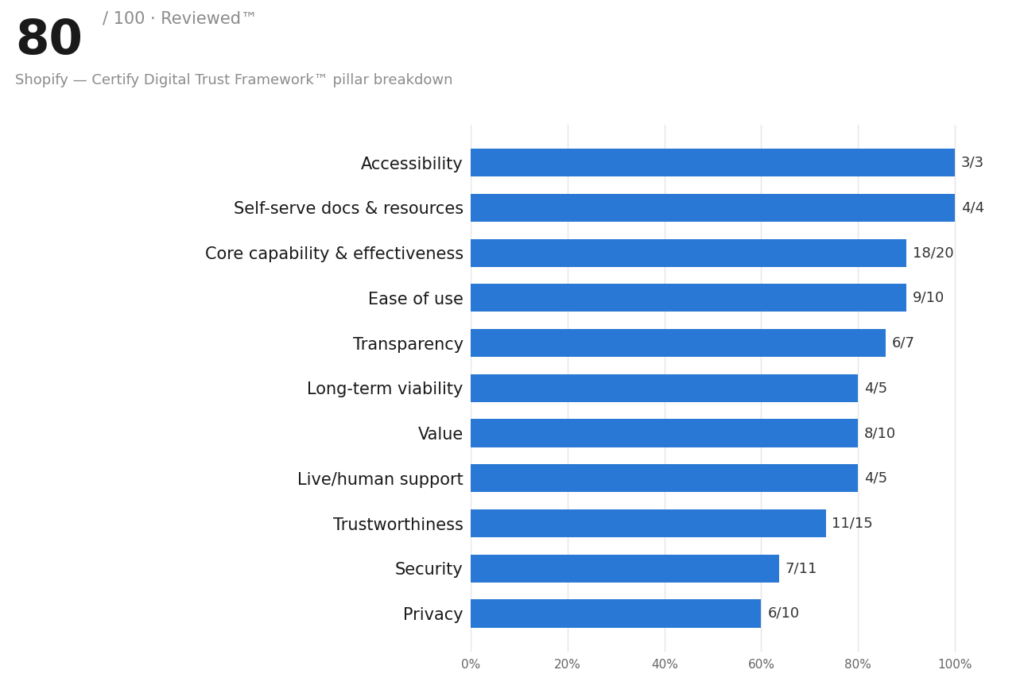
80/100 — Reviewed™
This score was revised down from an initial 83 after we applied our Remediation Sub-Rubric. Two things changed: the 2024 incident’s disclosure was weaker than we first credited, and the 2025 Consentik vulnerability was fully weighted rather than mentioned in passing.
Confidence Level: Medium — Grounded in extensive real-world, hands-on experience with Shopify merchants and then supplemented with independent research into Shopify’s incident history. This score reflects the evidence available today, not a fixed verdict — like every recommendation here, it’s revisited as new evidence emerges.
Bottom Line
Shopify earns its Reviewed™ badge honestly.
The core platform is mature and the ecosystem genuinely solves the “what happens when my business grows” problem better than most alternatives — and day-to-day usability is strong.
The trade-offs are real but manageable: budget for the full stack beyond the base plan, understand that support quality tracks your plan tier, and don’t take third-party app badges at face value — vet what you install, even the “verified” ones.
We use it. We recommend it. Just go in with your eyes wide open.
Frequently Asked Questions
Is Shopify a good choice for a new online store?
Yes, for most. Certify Digital scores Shopify 80/100 — Reviewed™. It’s best suited to businesses that want a proven platform with room to grow, access to a large pool of developers and agencies, and a mature app marketplace instead of custom-built integrations.
Has Shopify been breached?
Shopify’s core platform has no documented breach. There are three disclosed security and privacy incidents over five years, and each traces to insider misuse or the third-party app ecosystem rather than the platform itself. No payment card data was exposed in any of the three; customer personal data was exposed in all three.
Can I trust the “Made for Shopify” badge?
Not on its own. In 2025 an app called Consentik carried the badge and a 4.9-star rating while exposing data across roughly 4,180 stores for at least 100 days before outside researchers caught it. Vet apps yourself, especially any requesting broad data access.
What does Shopify actually cost?
More than the base plan. Most ecosystem apps carry their own subscriptions, so the real monthly cost of a fully-featured store runs above the sticker price. Check transaction fees separately if you’re not using Shopify Payments.
Do I need a developer to launch on Shopify?
No, not to get a functional store live — the platform is well-documented and doesn’t require deep technical skill compared to a custom build. Having a developer available is still worth it as complexity grows.
When is Shopify the wrong choice?
When you have unusual technical requirements the app ecosystem doesn’t serve, you need full control over your codebase and infrastructure, you’re highly cost-sensitive at low volume, or you’re already invested in a competing platform with no real reason to migrate.
Resources
If you’re considering Shopify or already using it, these resources can help you evaluate the platform, understand the costs, explore the ecosystem, and find experienced help.
- Shopify Pricing & Plans — Compare Shopify’s current plans, features, payment rates, and pricing.
- Shopify App Store — Browse Shopify’s ecosystem of apps for subscriptions, email marketing, reviews, loyalty, shipping, analytics, store design, and other functionality.
- Shopify Theme Store — Browse free and paid themes built for Shopify stores.
- Shopify Partners Directory — Find Shopify developers, designers, agencies, consultants, and other experienced Shopify professionals.
- Upwork Shopify Developers & Freelancers — Another option for finding independent Shopify developers and specialists for store builds, customization, integrations, and ongoing work.
- Shopify Help Center — Official documentation and help resources for setting up and managing a Shopify store.
Related Certify Digital Recommendations
- Shopify Decision Hub — Browse every recommendation we’ve published in this hub.
- Should Your Business Use Claude? — Our evidence-based recommendation for business owners considering Claude as a primary AI assistant.
Evaluated using the Certify Digital Trust Framework™.
Full methodology at certifydigital.com/methodology.